Boris Yakovlevich Vorobyov (1911–1990) was a Soviet animal sculptor and an Honoured Artist of the RSFSR who worked at the Lomonosov Porcelain Factory in Leningrad (LFZ) from 1936 to 1972. The catalogue of the Don Foundation lists 4 works under his name – small-scale porcelain sculpture. Prices: from 15 to 290 $. Below: the sculptor’s biography, what the section contains and the rule by which the authorship of a model is established.
Boris Yakovlevich Vorobyov was born on 6 November 1911 (24 October in the old style) in Tomsk and died on 25 April 1990 in Leningrad. Before he began his training he had changed occupations several times, working as a bricklayer’s mate, a schoolteacher and an aerial gymnast in the circus. From 1932 to 1935 he studied at the Moscow Institute of Architecture and Civil Engineering; in 1936 he entered the sculpture faculty of the Institute of Painting, Sculpture and Architecture of the All-Russian Academy of Arts in Leningrad, graduating in 1946 with a wooden “She-Wolf in a Trap”. His teachers there were V. S. Bogatyrev and A. T. Matveev. He had been urged to take up sculpture seriously by the painter I. I. Brodsky and the animal sculptor V. A. Vatagin, who noticed his work at an exhibition of amateur artists in 1935. An animal rather than a human figure as the subject of a diploma work was a rare case in the academic tradition.
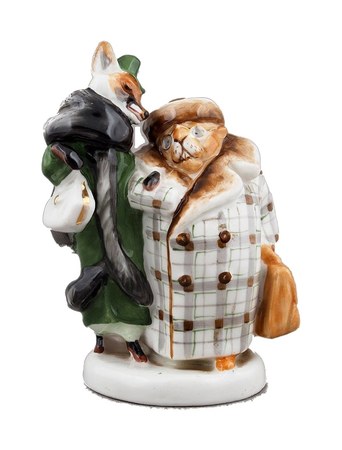
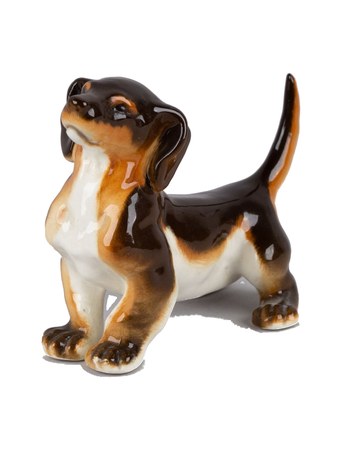
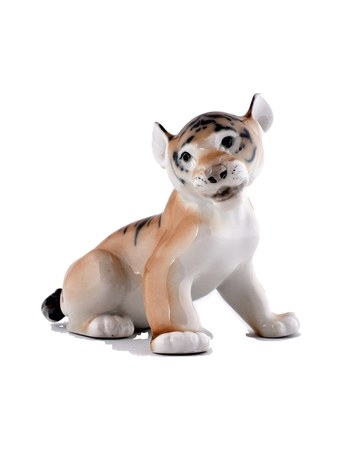
Small-scale porcelain sculpture is what Vorobyov is best known for: he joined the factory in 1936, while still a student, and stayed until 1972. In the catalogue of the Don Foundation the pieces after his models sit in the decorative and applied arts section. They include “Tiger Cub” and “Dachshund”: the manufacturer itself – the Imperial Porcelain Factory, successor to LFZ – names B. Ya. Vorobyov as the author of both models, and both are still in production today; “Tiger Cub” is a model of 1954. The same group includes “The Fox and the Beaver”, after the fable of the same name by Sergei Mikhalkov: the model is by Vorobyov and the painting design by I. I. Riznich. The technique, dimensions and dating of each item are given in its lot record where known.
Small-scale porcelain sculpture is produced in editions: the factory made Vorobyov’s models in large runs and often marked the piece with the factory stamp alone, without the name of the sculptor. Authorship is therefore established from the model rather than from a signature, and the correct formula for such pieces is “after a model by B. Ya. Vorobyov”, while the year a particular example was produced is read from the factory mark. Besides porcelain, Vorobyov worked in faience, majolica, ceramics, glass, wood and metal. In 1972 he left the factory over disagreements about the demands of mass production and worked mainly in wood for the rest of his life; some of that work is in the Darwin Museum in Moscow. A related catalogue section is sculpture.
During the 1950s Vorobyov made porcelain series on literary subjects: characters from Gogol’s “Dead Souls” and “The Government Inspector”, from the fables of Krylov and Sergei Mikhalkov, and figures from Chekhov – “The Fox and the Beaver” belongs to that group. He was an Honoured Artist of the RSFSR and won a silver medal at the 1958 Brussels World’s Fair (Expo 58) for his majolica “Himalayan Bear” and porcelain “Panther” – an award unrelated to the items offered here. Beyond porcelain, he was co-author of the “Elk” monument in Monchegorsk: the bronze figure, 4.3 metres high, was installed in 1958 on Pyat Uglov (Five Corners) Square (second sculptor A. V. Degtyaryov, architect S. E. Brovtsev). For his centenary the State Hermitage held a solo exhibition, “Sculptor Boris Vorobyov. Porcelain, Graphics” (21 December 2011 – 1 April 2012), and in 2015 the Russian Museum showed “Boris Vorobyov. 1911–1990”. His works are held by the Hermitage, the Tretyakov Gallery, the Russian Museum, the Kuskovo museum and the Darwin Museum; this concerns his work, not the items in our catalogue.
The Don Foundation holds online sales. Prices for his works in the catalogue are from 15 to 290 $; each work’s price is on its card: a work can be bought straight away, or at the online auction if it is up for sale there. The lots can be viewed in the catalogue and in the artists section, the schedule of forthcoming and past sales is on the auctions page, and registration and bidding are explained under how to buy. If you own porcelain after a model by Vorobyov and wish to consign it, start with how to sell: a preliminary valuation requires photographs of the piece, including the factory mark, and whatever is known of its history.